
Artist-in-Residence Sammy Yuen: AAPI Histories on an Historic Highway
Illustrator Sammy Yuen's first exhibition at Pearl River Mart focused on Manhattan Chinatown, its businesses, landmarks, and residents. His new exhibition goes beyond.
Coinciding with the historic highway's 100th anniversary, Sammy's exhibition, Shared Lines (which is dedicated to his father who passed away this May), features stories of Asian American communities along Route 66. One of the original highways in the U.S., Route 66 stretches nearly 2,500 miles from Santa Monica, CA to Chicago, IL. According to the National Trust for Historic Preservation:
“The Mother Road,” as [Route 66 is] often called, represents a significant moment in history that continues to define the nation’s identity: the rise of the automobile and its implications of freedom, mobility, and a uniquely American story.
While officially decommissioned in 1985, Route 66 still has its fair share of supporters. The National Trust, Road Ahead Partnership, and other state and local partners are seeking a National Historic Trail designation for the highway.
Sammy's show is another way to preserve the important history of the highway and the stories of the community that resided alongside it. We had the chance to talk to Sammy about his life-changing road trip and what he saw along the way.
The last time you showed with Pearl River Mart was back in 2022. What in your life and work has changed since then?
Drawn Together was the catalyst for everything. That immediately led to the 2023 Route 66 project with the National Trust for Historic Preservation.
What was the project about?
It was about exploring the Asian American communities along Route 66. That year I took a road trip with my family from Los Angeles to Chicago. That experience was really eye-opening. It was very stressful because everything was up in the air, but at the same time I learned so much.
I started in Los Angeles and went to the Chinese American Museum there, which was built in an old teahouse/convenience store. From there we went east. Since Route 66 is decommissioned, we had to try and find certain landmarks. My kids thought it was really fun. Something we looked for were these two guardian lions. They were mysteriously placed in Amboy, CA in 2013. They're six-foot-tall lions on three-foot cinderblocks. My daughter was the first to see them. That was one of the highlights.
No one knows where they came from. One theory is that they came from Albert Okura, a Japanese American restaurateur and preservationist. In 2005 he purchased Amboy, which was basically a ghost town, pledging to restore it. It's thought that his kids wanted to see his vision through so they installed the lions there, although that's not confirmed. Regardless it's one of the ways that shows how people wanted to establish their roots there along the highway.
What was your next stop?
Arizona, a town called in Kingman. In the 1880s, the southern portion of the transcontinental railroad was built there by Chinese laborers. After the railroad was finished, they stayed and created a community with businesses and restaurants. The water towers are a significant landmark because they were originally constructed to support railroad operations.
A local historian introduced me to the Mohave County Historical Society. They actually have a lot on AAPI history there. I was there for four hours poring over everything they had. I learned that during World War II, 33 Chinese American cadets were stationed there. They were tail gunners since they were smaller and could fit in that tight space. Some had returned to China but came back to the U.S. to serve during the war.
I understand you created an imagined neon sign for somewhere along Route 66. Can you talk about that?
That was in Albuquerque, New Mexico. I met an anthropologist there, who suggested we see Route 66 at night. When we passed the International District — which is the most diverse part of the city — I noticed many dark spots. Even if a business had a neon sign, it wasn't on. Despite the area having a lot of restaurants and a big grocery store, there wasn't any signage.
When I got back to New York, I thought maybe I should try designing a sign. I spoke to the National Trust, and they helped secure a $75,000 grant from the National Endowment of the Arts that would help cover the costs.
However last May, the grant was canceled along with hundreds of others. Despite that the Albuquerque community raised the money to design and build the sign. Using my drawing as a jumping off point, the city involved local artists and residents. Ultimately four local artists were chosen. They held workshops and each produced a sketch based on feedback from the workshops. Their goal is to build the sign by November of this year, for the 100th anniversary of Route 66.
At the moment, the project is on hold again. The staff members in Albuquerque who were overseeing it were let go and replaced, so I don’t currently know whether it will move forward. I remember at the initial launch meeting, the organizers asked what would make the project successful, and someone replied, “If it actually happens.” That really stayed with me. One of the challenges of public art and art activism is that many projects begin with excitement and momentum but never reach completion. It can be discouraging, but it’s also why it’s important to keep trying and to continue creating work that sparks conversation and brings communities together.
How did you end your trip?
Our last stop was Chicago. I met with temporary executive director of the Chinese American Museum of Chicago and she took me around Chicago Chinatown. I ended up exhibiting Shared Lines there.
The site of that museum has an interesting history as well. One of the main benefactors, Raymond Lee, donated the Quong Yick & Co. grocery store building to them. Quong Yick was started by Lee's great-grandfather, and Lee himself lived on the third floor when he emigrated from Guangdong, China when he was 15.
Why do you want to show Shared Lines at Pearl River Mart?
This whole journey started with my first exhibition at Pearl River Mart. Showing Shared Lines there brings it back, full circle. I also like the idea of exploring Asian American communities outside of New York City's Chinatowns. Beyond Manhattan and Flushing. Sometimes it's just a strip mall or restaurants spread out in an area. But the stories of the people are often the same.
Shared Lines: Asian American Stories on Route 66 will be on view in the Pearl River Mart gallery from June 6 to Sept. 27, 2026.
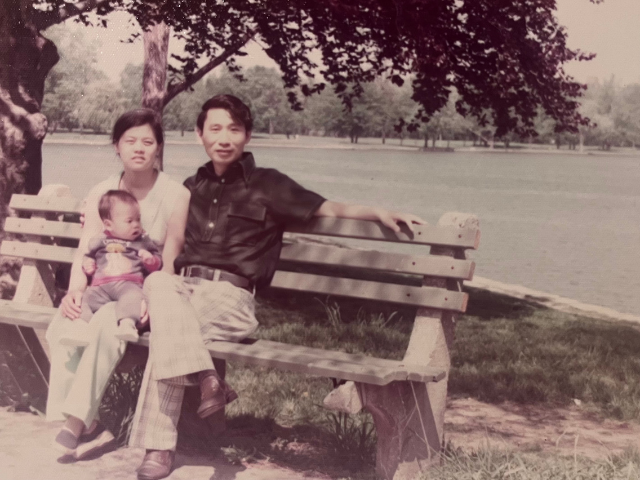
[Image: Sammy as an infant with his parents]